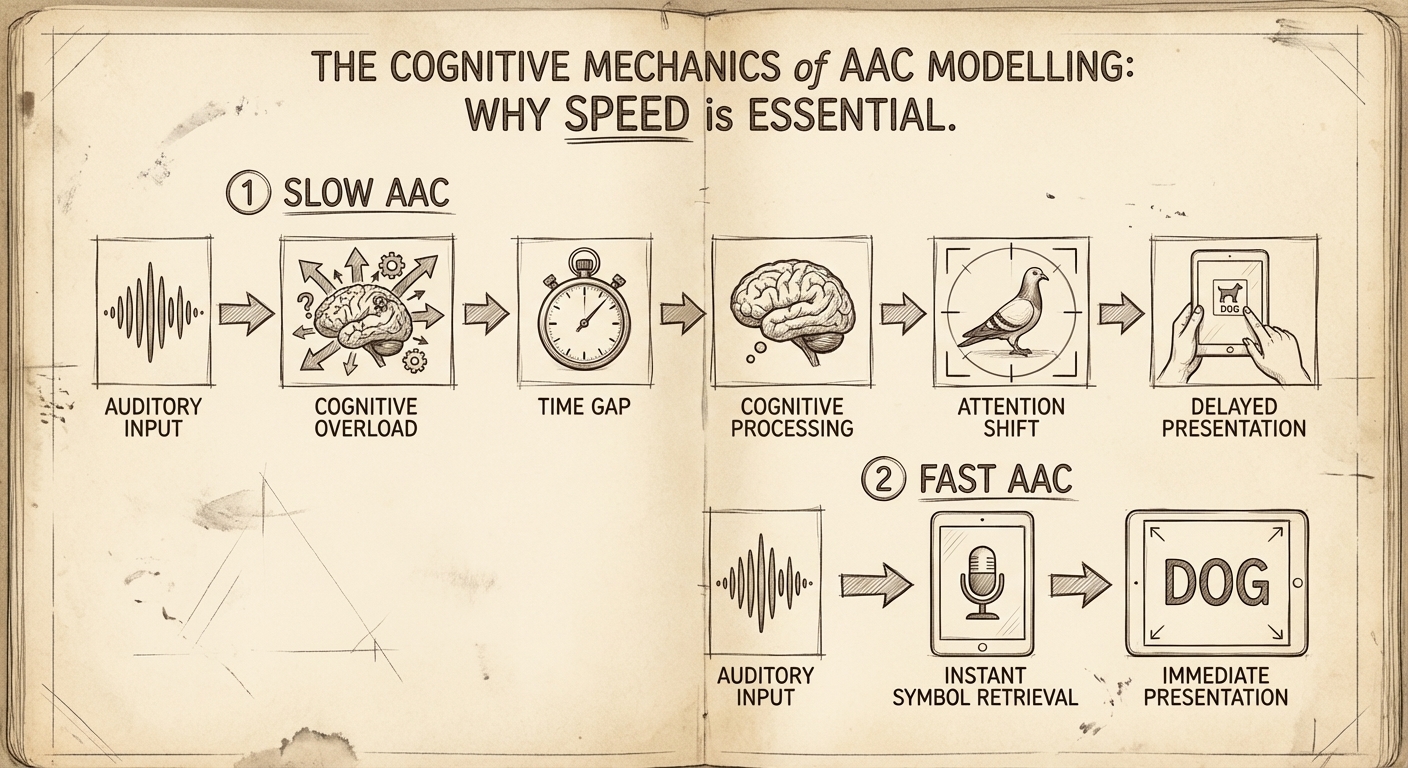
You're at the park with your child. A dog runs past and your child's eyes light up. This is the perfect opportunity to show them the symbol for "dog" and connect it to what they're experiencing right now.
You reach for the app. Open it. First press the home button. Tap into Animals. Scroll past cat, bird, fish. You find the dog symbol. You turn the screen toward your child. But they're watching a pigeon now, or looking at their shoes, or simply somewhere else entirely. The moment has passed.
This scenario plays out countless times for families using AAC. Not because parents aren't trying, but because the tools aren't designed for how the brain actually learns.
What's happening in the brain?
The brain forms connections through association. When two things happen together, they become linked. This principle, known as associative learning, underpins how we acquire language. A child hears "dog" while seeing a dog, and over time the word and the concept become inseparable.
But timing is everything. The closer two stimuli occur in time, the stronger the association. This is called temporal contiguity. When there's a delay (even a few seconds) the connection weakens. The brain has already started processing new information, and the link between the moment and its symbol becomes diluted.
This is the hidden cost of slow AAC navigation. Every second spent searching through folders and categories is a second where the child's attention drifts. By the time the symbol appears, the brain is no longer primed to connect it with the original experience. The modelling opportunity can disappear and people who could benefit from AAC might give up.
What happens during the delay?
Consider what a ten-second search actually looks like from your child's perspective. The parent is looking at a screen, tapping through menus. The child's attention, which was right there in the moment, naturally shifts to whatever comes next. A sound. A movement. A thought.
When the symbol finally appears, the original context has faded. The brain is no longer holding that experience in working memory with the same intensity. The symbol arrives, but it arrives disconnected from the moment that gave it meaning.
This isn't a failure of effort. It's a failure of design. Traditional AAC tools prioritise logical organisation over speed of access. Words are arranged in categories that make sense to adults such as animals, food, feelings, actions. But the brain doesn't learn language through taxonomy. It learns through context, repetition, and timing.
Why speed changes everything
When symbol retrieval is instant, something shifts. Modelling stops being a structured activity and becomes part of life. The car journey becomes a modelling opportunity. So does breakfast, bathtime, the walk to school, the moment before bed.
Fast modelling means:
- More moments captured throughout the day
- Stronger associations formed through precise timing
- Reduced cognitive load for the parent or therapist
- Increased repetition across varied natural contexts
- Less pressure to create artificial "teaching moments"
What does this mean for AAC systems
The implications for AAC tool design are clear. Interfaces that require navigation through categories and folders introduce friction at exactly the wrong moment. Search-first design is where a word can be found instantly through voice or text therefore removing that friction. The symbol appears while the moment is still alive.
Fullscreen display takes this further. When a symbol fills the screen with nothing else competing for attention, the child doesn't need to be directed to look. The symbol is simply there, clear and unmissable, paired with its audio and connected to what's happening right now.
This isn't about replacing the AAC systems that support independent communication. It's about recognising that modelling has different needs. The goal of modelling is to build understanding to help the child learn what symbols mean before expecting them to navigate to those symbols themselves. That learning happens fastest when the gap between experience and symbol is as small as possible.
The research supports what many parents sense instinctively: those fleeting everyday moments matter. But they only matter if we can capture them. Speed isn't a convenience feature. It's the difference between a symbol that connects and one that arrives too late.